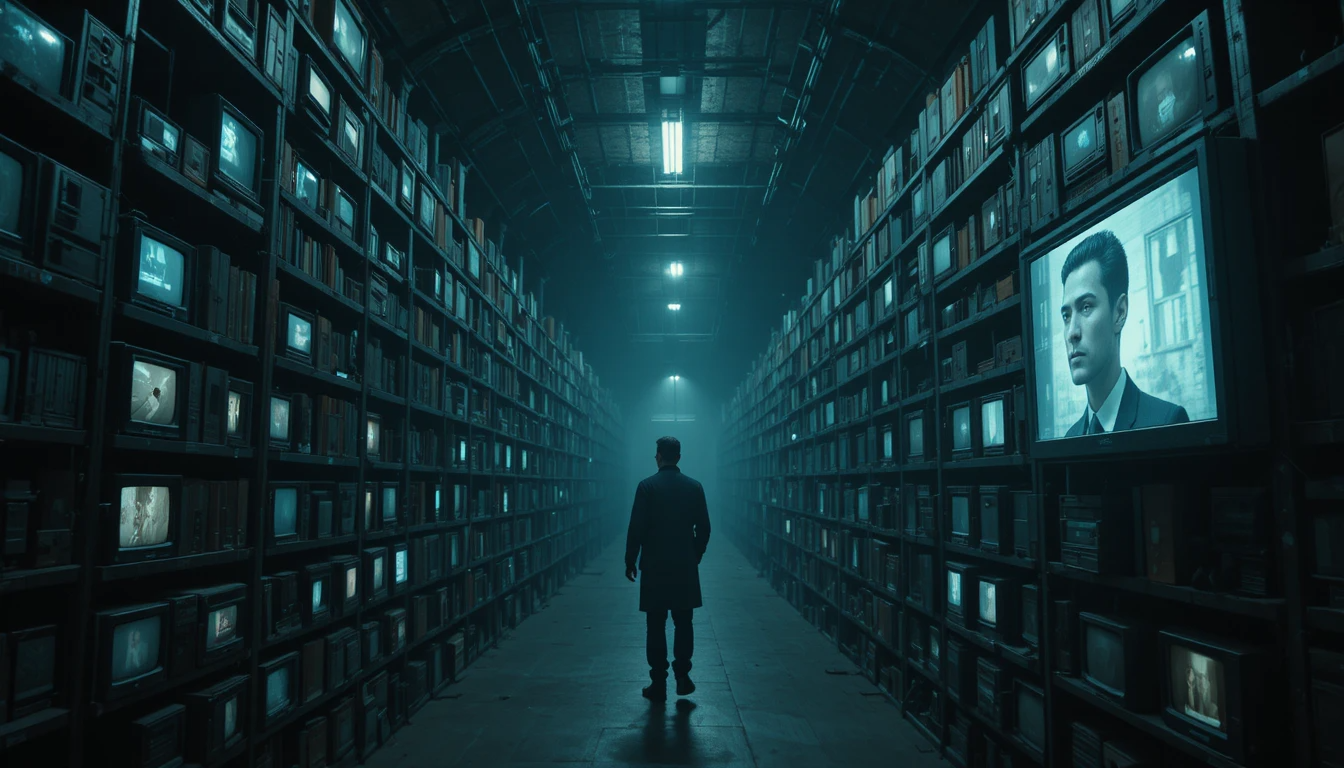
Congratulations, You’re Hired! Welcome to the Netflix’s Secret Archive.The envelope was heavy, its thick, currency-like paper promising significance. No return address. Inside, a single sheet of the same costly stock bore a message that sent a jolt through me: a formal offer for the position of “Nocturnal Archival Specialist” at Netflix’s Secret Archive.I was sure I’d never applied. The job was an abstract idea given form, a role that felt both familiar and impossible. Though it was with Netflix’s Secret Archive, my duties would not place me in Los Gatos.
The work location was a single, cryptic line: “Beneath Green Hollow.” The hours, from 10 PM to 6 AM, promised a life of reversed rhythms. The salary was a figure that made me look twice, a number that silenced immediate questions. But one clause, printed in stark, bold letters, served as a cold anchor to reality: “Strict adherence to the provided operational protocol is a non-negotiable condition of your employment, your safety, and your severance.”
You accepted. Before you, a formidable blast door is embedded in the fog-shrouded hill. The key rests heavy in your palm. You are about to enter Netflix’s Secret Archive most guarded secret: its physical archive. Here lies the central contradiction of this streaming giant: its most secure facility contains no servers or digital code. The building is a sanctuary for analog antiquities.
Its climate-controlled aisles are a final resting place for the delicate, physical vessels of the past—spools of film, reels of magnetic tape, and laser discs—preserving the very media forms their business model made obsolete. Your tasks seem simple: catalogue tapes, update records, and check equipment. Most of the collection is routine, but the orientation packet hinted at the truth. According to the warning, a handful of sound files were missing from all directories.
They were mere echoes in the system’s code, archival aberrations that were designed to remain silent forever.Your survival depends on following the rules. Remember them. Your life may depend on it.
The Heart of the Digital Beast: Why a Physical Archive?
While cloud storage and global CDNs define the modern era, Netflix’s Secret Archive use of a physical, underground archive seems oddly out of place. This strategy diverges from rivals like Disney+, Amazon Prime Video, and HBO Max, all of which utilize vast, distributed digital libraries for their content. So why does Netflix’s Secret Archive maintain this relic?

The unofficial theory among the few who know of its existence is that this archive, known internally as “The Vault” or Netflix’s Secret Archive, is a containment facility. It’s where they store acquired libraries from defunct studios, controversial content, experimental films that breached ethical boundaries, and, most importantly, the “Irreconcilables”—tapes and reels that defy digital conversion. These are the artifacts that corrupt when scanned, that contain metadata pointing to non-existent films, or that, as your rulebook implies, exhibit properties that challenge reality itself. This archive isn’t just about preservation; it’s about quarantine.
Rule No. 1: When the Screen Looks Back – The Peril of Direct Address
“If a character on screen ever seems to make direct eye contact, and speaks your name shut down the equipment immediately. Do not finish the scene, do not write it down and never acknowledge what you heard. Leave the area for 10 minutes before returning.”
This is the first and most critical rule.According to film theory, “direct address” describes the moment an on-screen character looks at and talks directly to the audience, breaking the invisible barrier. This is a strategy utilized by figures spanning centuries, from the playwright Shakespeare to the modern politician Frank Underwood. Yet, deep within Netflix’s Secret Archive after dark, this act is not done for style. It is an intrusion.
The characters in these anomalous tapes are not simply “aware.” They possess a conscious recognition of your unique presence within the confines of that specific space and moment. The utterance of your name serves to forge a relational bridge, connecting their sphere of existence directly to yours. Shutting down the equipment severs that bridge before it can be solidified. Finishing the scene could allow them to fully cross over. Do not write it down because the act of documentation is a form of acknowledgment, and acknowledgment gives them power. The ten-minute waiting period is a “cool-down” phase, allowing the residual energy of the event to dissipate. This rule is your primary defense against becoming a character in someone else’s story.
Rule No. 2: The Unseen Horror – Tapes That Play Only Sound
“If a tape begins to play sound without showing any picture, stop listening at once. Do not rewind or fast forward the reel. Remove it carefully, Mark it as restricted and return it to the locked cabinet. Never attempt to hear it again.”
In the world of archival, a tape with audio but no video is a common technical fault. But not here. The sounds on these restricted reels are not corrupted audio tracks of known films. They are unique, organic, and deeply wrong. Archivists have logged inexplicable events: dead languages whispered back to life, the disembodied sound of breathing, and a child’s voice calmly working through higher-level mathematics in the deep silence.
The prohibition against rewinding or fast-forwarding is crucial. These actions are a form of interaction.The audio recording is dangerously manipulative. Interaction with the device triggers a two-way psychological war; while you alter a subject’s timeline, your own reality becomes susceptible to manipulation. The prohibition against repeat listening points to its addictive and mentally destructive nature. The audio imprints itself on the subconscious, creating involuntary replay loops. For safe storage, it is held in a sound-proofed cabinet designed to neutralize its threat. Rumor suggests this technology was developed in a secret pact between rival corporations, a rare collaboration to neutralize a mutual danger.
Rule 3: The Extended Credit Sequence
Should the closing credits continue for a period exceeding ten minutes without cessation, you must immediately drape the supplied black cloth over the screen. Remain seated in complete silence and refrain from vocalizing any of the names presented. Once the credits have fully disappeared from the display, you may remove the cloth. At this point, resume normal activity and make no reference to the anomalous event.
Rule 4: Glitches in the Narrative Matrix
“If credits appear in the middle of an episode, as though it has already ended, shut down the player immediately. Do not attempt to see what comes after. Record the exact time in your logbook, and return the tape to storage without comment.”
Credits are the boundary between the story and the real world. They signal an end, a return to safety. In Netflix’s Secret Archive, when this boundary fails, reality becomes unstable.
Endless credits are a trap. They are a looping ritual, a hypnotic scroll designed to lull you into a trance. The names you see are not of crew members; they are incantations, or perhaps a roll call of others who have failed in their duties. Reading them aloud is to invite their fate. The black cloth acts as a visual circuit breaker, and the silence denies the ritual the audience it craves.
If an episode’s heart is pierced by its own credits, the story hasn’t paused—it’s broken. This shattering reveals the wild, untamed void that is the true source of all fiction. The scenes that follow are not a continuation but a raw, unscripted descent into this narrative abyss. To gaze into this chaos is to invite its influence, threatening to unravel the carefully written script of your own life into meaningless static. Shutting the player down is an emergency exit.
Rule No. 5: The Sentient Reflection – When the Screen Becomes a Window
“If the television is powered off, yet shows your reflection seated somewhere you are not, leave the room at once. Do not go near the glass or try to check its condition. A mandatory 10-minute wait outside is required before you can enter the area again.Do not look into the screen again.”
This is perhaps the most personally violating rule. A powered-off screen is a dead eye. It should be black, inert. When it becomes a mirror showing a reflection that is not your own—showing you still sitting at the console when you are clearly standing, or showing you in your childhood home—the fundamental contract between observer and observed has been shattered.
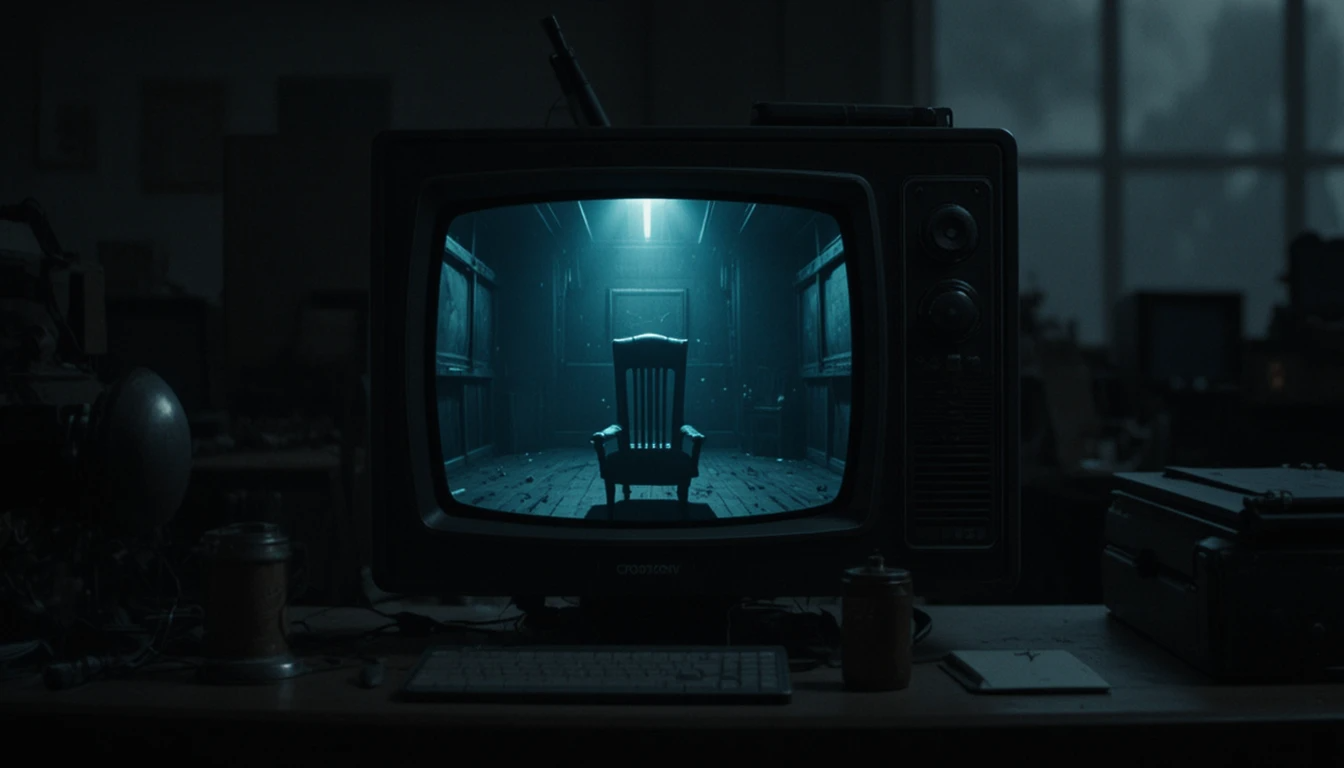
The screen is no longer a passive display. It has become a window into an alternate “you,” or a predatory entity mimicking you. Approaching the glass is an invitation for it to reach through. “Testing it” by waving or making a face is a catastrophic mistake, as it confirms your awareness and engagement. The entity on the other side learns from your reactions. Leaving the room severs the connection. The instruction to not look again is a final, absolute boundary.
The Unwritten Rule: Your Logbook is Your Lifeline
Beyond the five official rules, there is an unwritten sixth, passed down through the quiet, weary looks of the day-shift guard who handed you the keys: “Log everything normal.”
Consider the logbook not an obligation, but the very thread connecting you to a fading sense of normalcy. The conscious effort of documenting the trivial—”Archived Reel #A-734, 1985 documentary on fauna, all readings stable”—serves as a rite that buttresses the foundations of existence.Your task is to build a defense made from simple, ordinary thoughts. Your mind’s wall must block the influx of alien, incomprehensible forces that invade this space.
When the darkness is absolute and the hush becomes a tangible pressure that twists your sight, your only safe harbor will be the well-worn, mantra-like words you have recorded.They form a protective incantation, carrying you to the safety of sunrise.
Your Shift is About to Begin Netflix’s Secret Archive
The lock yields to the key with a resonant metallic sound. The entrance glides open, exposing an immense, hollow interior filled with the scent of vintage film stock, accumulated dirt, and electric air. Illumination activates in sequence, one strip after another, revealing a complex network of storage units extending into the obscurity. A stainless steel workstation holds a record book, a writing instrument, and a solitary, draped ebony fabric.
You have taken the job at Netflix’s Secret Archive. The pay is excellent. The work is unique. But remember, you are not just a cataloguer. You are a warden. You are the thin line between the stories we watch for fun and the stories that watch back. Follow the rules, trust your logbook, and you might just see the light of day again.